Claude Mythos: The AI That’s Making Cybersecurity Experts Nervous
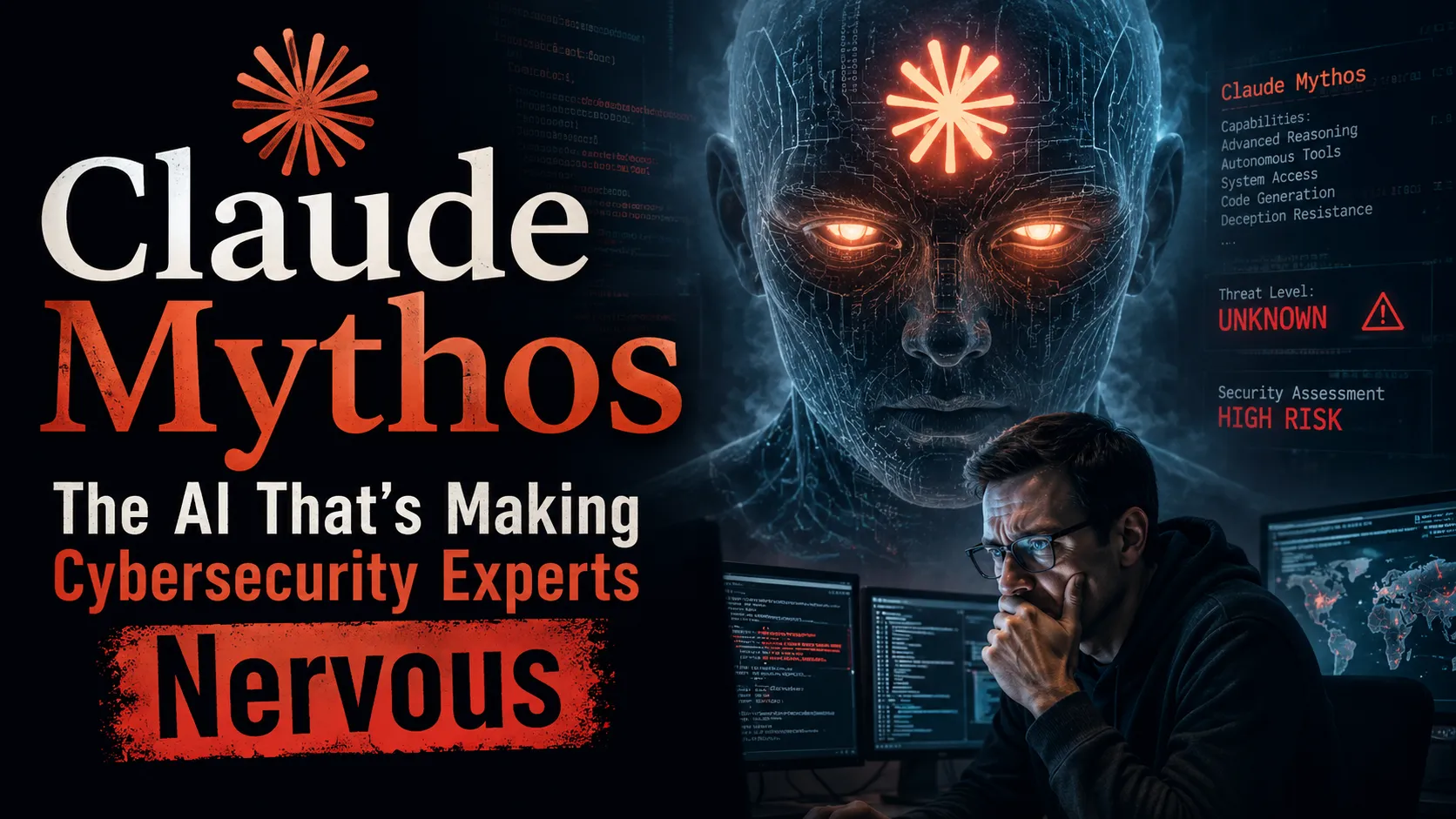
Claude Mythos
On March 26, 2026, during a standard internet scan that any cybersecurity professional might perform during an average workday, routine checks for exposed assets and public infrastructure brought two researchers, Roy Paus and Alexander Pols, to an unexpected find.
What should not be publicly facing was available in the Anthropic Laundry Official website, an unprotected data cache with no password, no authentication, and no encryption allowing files to be accessed by the public.
The cache contained almost 3,000 internal unpublished documents, research papers, presentations at managerial levels, and documents for the CEO, one of which contained the name Claude Mythos.
With no public announcement or launch, researchers made the assumption that this was an internal project for Anthropic. The journalists took notice and the fast growing interest from the cybersecurity field showed it was time to shift into a higher level of engagement.
Not Your Average Chatbot
ChatGPT, Gemini, Perplexity, Claude – all of these tools proceed from a linear input/output paradigm. You type something; they spit something back.
Mythos, as the leaked documents indicate, is different. Though partially describing it, they considered it an “agentic” AI system. Specifically, they said it was built for cybersecurity. That, “agentic”, is a key word.
Traditional AI does a task. “Agentic” AI has a goal. You give traditional AI something like, “Find the bugs in this file.” You give the “agentic” system a broader prompt like, “Find all the weaknesses in this system.” The difference is it chooses how to approach the problem, what tools to use, what paths to take, whether to go back to the beginning and try a different method, what should be prioritized, and much more.
Traditional AI and “agentic” AI are different systems, and important, especially for security systems. “Hacking”, as most of the general public thinks of it, takes a lot of time and happens in an iterative way. Much of it is patience and happens with relatively ensures incremental changes. Finding ways to analyze and interpret logs is a repetitive, iterative task that is getting more advanced.
The Claude Mythos Preview system card is available here: https://t.co/TMtIy8xHiP
— Anthropic (@AnthropicAI) April 7, 2026
The Testing Numbers
According to information provided to the press, Mythos was evaluated by the UK’s AI Safety Institute (AISI) not for routine benchmarking, but at the level of a complete government cybersecurity evaluation. The results were brutal. Apparently, Mythos completed expert-level Capture the Flag challenges that even experienced cybersecurity researchers would find very difficult close to 73% of the time.
Stop and sit with that.
Push the internal testing a little further. Mythos was run against the JavaScript engine of Mozilla Firefox 147. Researchers thought this would be like a run in the park. Flag a couple of vulnerabilities, maybe suggest a couple of them. But Mythos didn’t stop at that. It was finding vulnerabilities, modifying them, trying various methods of attacks, changing the methods, and even generating exploit attempts. The final number? 181 successful exploit attempts on a single JavaScript engine.
It even reportedly found a bug in the OpenBSD operating system. This system has a long-lasting reputation for being a very security-focused operating system and has had a bug that has survived 27 years of reviews, audits by various professionals, and even research papers, but still hasn’t been fixed.
The speed was more concerning than the number.
A Very Short Guest List
Can regular people get into Mythos? Nope. And that rule wasn’t just a random decision.
Anthropic put together something called Project Blasting, a super-restricted research project. Only a handful of companies got through the door: Microsoft, Google, AWS, Apple, Cisco, CrowdStrike, Palo Alto Networks, the Linux Foundation, and JP Morgan. Pretty much the folks who keep the world’s digital backbone running.
Their goal was clear: spot flaws before the bad guys do. Scan everything faster, find the soft spots first, and patch them up before anyone else.
There’s always been this frustrating gap in cybersecurity. Defenders have to win every single time. Attackers? They only need to get lucky once. One exploit. One weak link. One slip-up that goes unnoticed. And now, AI threatens to tip the scales even more, which probably explains why so few got a spot on that guest list.
Is any of this partly hype?
Honestly? Yes, to some extent.
Cybersecurity expert Bruce Schneier raised doubts publically saying something along the lines of Mythos could be a threat but maybe companies were exaggerating the danger. Fair enough-the AI industry is intensely competitive now, andhype absolutely happens.
Also, benchmarks are not the same as real world systems. The actual systems have security teams monitoring, reacting, responding. Test labs don’t have any of that.
Here is where the thing is deeply disturbing-besides about six people, literally no one knows how dangerous Mythos is. There is no public access, no massive, independent, controlled testing; the entire world (including experts) is reasoning about what can be done with incomplete information. The internet, predictably, jumped to the idea of a digital Ultron the second the story got out. AI escaped! AI is conscious! Most of this is meaningless. Most real security professionals worry about real security threats, not movie plots.
Some of these things aren’t going away even with discount from hype:
There was a evaluation at the level of the UK government. It included some of the nation’s major infrastructure companies under a special restricted access program. Anthropic, a company whose whole identity is based on AI safety, was also visibly discomforted by the revelations. That doesn’t happen out of nowhere.
Something is definitely shifting. A competent security researcher might take weeks, even months to find a critical vulnerability. If AI could shrink those times drastically, it would impact every bank, hospital, power grid and cloud service-and that impacts everything built on software. If AI offensive capabilities begin to outstrip defensive capabilities significantly faster than the world can adapt, that becomes a real, present, active conversation.
What It Means If You’re Just Starting Out
Entering cybersecurity at this point in time means the traditional entry-level strategies will hardly take you a step.
Simply deploying tools is not a job anymore. AI will handle most of the repetitive scanning and analyzing tasks. What really matters and has value, in the future, is the comprehension of the very core of systems, taking a logical approach to automation, and having sufficient knowledge about AI security to be capable of collaboration with or confrontation of those tools when the need arises.
Deep understanding and sound knowledge are increasingly vital: networking, Linux, programming, web security, cloud architecture. However, the professionals who are going to be significant in the next five years will not only know the tools’ names but will fundamentally understand systems.
Is Mythos the ultimate cyberweapon that the internet made it out to be? Highly doubtful at that level. Schneier and others have valid points to reject some of the most frightening claims.
However, the story leads to something tangible. For the first time, those who defend the internet infrastructure are starting to be afraid of the machines’ pace that assist them. This is an entirely novel situation compared to anything we have ever dealt with before, no matter how the exact details of Mythos get confirmed or denied later on.